Case Study
BA
From 74% to 96% — Closing a Certification Gap Through Root Cause Analysis
Company
A Fortune 500 IT company
BAU
Internal certification programme
My Role
L&D Specialist (Solution Design)
Time
2020 - 2021
At a Glance
01
Clear problem, measurable target
Regional certification coverage sat at 74% against a global target of 90% — with a 4-month deadline.
02
Data analysis identified where to look
Internal certification status data across 500 employees was downloaded from the ERP and analysed in Excel — mapping gaps by department and building a targeted sample for structured interviews.
03
Root cause found through direct research
Structured interviews with the targeted sample revealed the real barrier: no documentation guiding employees through the process — not lack of motivation.
04
Solution matched the root cause exactly
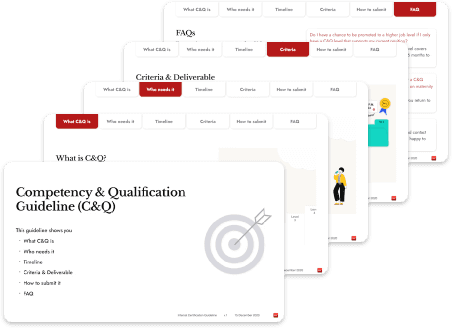
A four-component documentation package replaced informal peer guidance with a clear, consistent, self-serve process.
05
Target exceeded ahead of schedule
Coverage reached 96% before the June 2021 deadline — tracked after each closing period — the highest in the region.
The Snapshot
Background
The company runs an internal certification programme to ensure employees' roles and competencies are formally aligned. After being hired, employees submit deliverables for evaluation and receive a certificate. The global target was for 90% of permanent employees to hold accurate certifications based on their positions.
In September 2020, the regional branch sat at 74% coverage — 16 points below target, with six months remaining.

Challenge
How can we increase internal certification coverage from 74% to 90% within 4 months?
Data Analysis
From raw data to the right question
Tool:

The ERP provided raw exports only — no built-in analysis. I analysed the certification status report across 500 employees in Excel, cross-referencing each employee's role against their current certifications to map gaps by department.
This built a targeted sample for structured interviews: active employees with missing
certifications, prioritised by where gaps were most concentrated — ensuring I spoke to the right people, not just the most available ones.
Coverage was tracked after each closing period to measure whether the intervention was working over time.
Needs Analysis
Uncover the root cause, not symptoms
Across departments, the interviews revealed three consistent patterns — none of which were about motivation:
Lack of awareness
Many employees didn't understand the importance or benefits of holding a certification. The programme existed — but its purpose wasn't visible to the people it affected.
Reliance on informal guidance
Employees navigated the process by asking peers or line managers — with no single source of truth. Information was inconsistent and often incomplete.
Reminder fatigue
The L&D team's reminder emails were perceived as repetitive and frustrating. They added pressure without providing the clarity employees actually needed.
The Root Cause
All three findings pointed to the same gap: no documentation existed to guide employees through the certification process. Without it, individuals pieced together information from informal sources — and the L&D team kept chasing the same people.
The reminder emails were treating a symptom. The root cause was a structural absence.
Solution Design
The 4 components of the solution
The solution design phase required close coordination with headquarters — aligning on calendar requirements, deliverable, assessment standards, and existing resources before anything could be built.
The final solution package contained four components, each addressing a specific gap identified in the needs analysis:



Coverage reached 96% before the June 2021 deadline — exceeding the 90% target and achieving the highest coverage in the region.
The solution worked because it addressed the root cause directly. Employees didn't need more reminders — they needed a map.
After the certification guideline succeeded, I applied the same needs analysis and documentation approach to other policies employees knew existed but didn't know how to use.
One addition — an external certificate reimbursement guideline — resulted in a 100% increase in employee applications within one month.
The pattern was consistent: when people have clear guidance, they act. The barrier was rarely willingness — it was access to structured information.
This project taught me that the most impactful interventions are often the simplest ones — once you've correctly identified the root cause. The team had been solving for awareness and motivation. The needs analysis revealed the real problem was documentation.
It also reinforced something I carry into every project: building structured guidelines and SOPs takes time upfront, but it removes the recurring cost of informal knowledge transfer and frees people to focus on the work itself.